The Four Foundation Acupressure Points: KI3, LV3, SP6 & ST36
Adapted from A Life Full of Light by Alexis Fotopoulos.
In A Life Full of Light, four points appear again and again as a practical foundation for meridian work: KI3, LV3, SP6 and ST36. I use them as a simple starting framework for learning how the Kidney, Liver, Spleen and Stomach meridians are traditionally understood to work together.
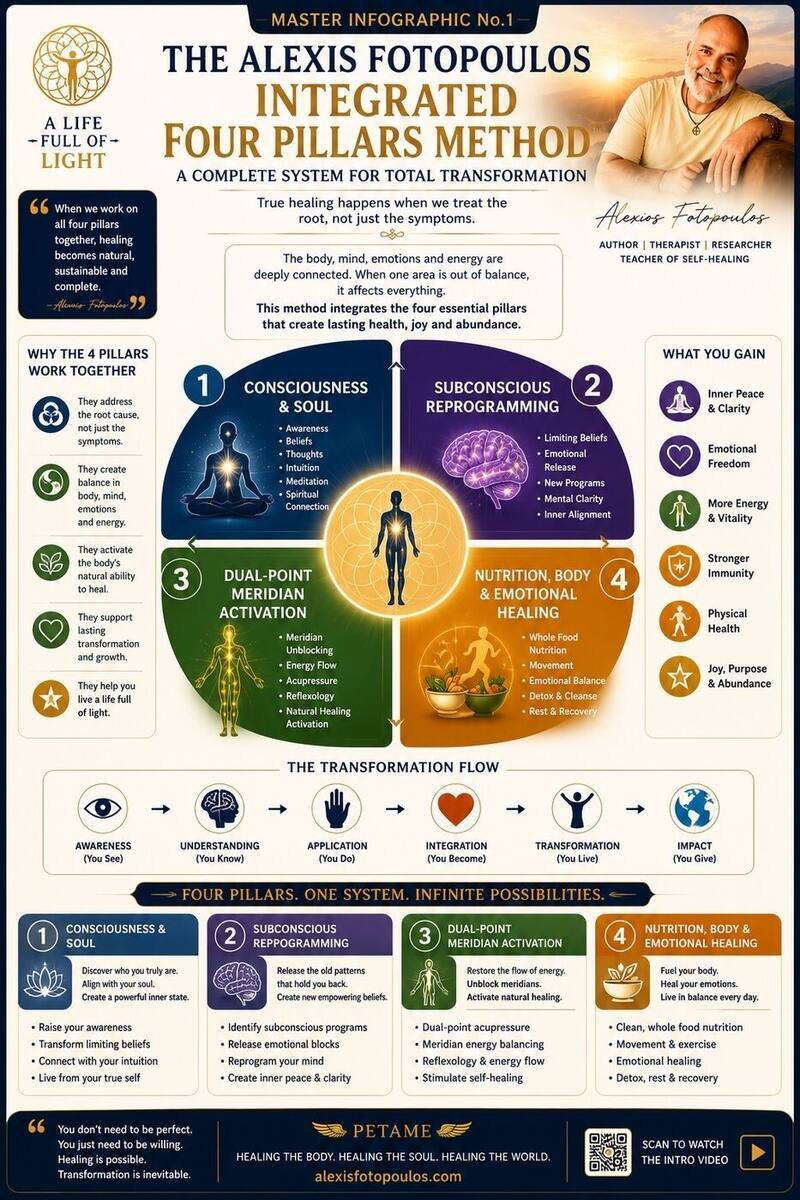
Why These Four?
Traditional Chinese Medicine describes health in terms of balance and the harmonious circulation of Qi. In my own method, these four points represent four complementary functions: Kidney — foundation, Liver — movement, Spleen — nourishment, Stomach — vitality.
This is a traditional energetic framework, not a modern anatomical model. The points should therefore be understood as complementary self-care tools rather than as replacements for medical treatment.
KI3 — Kidney 3 (Taixi)
Location: in the hollow between the inner ankle bone and the Achilles tendon.
Within Traditional Chinese Medicine, KI3 is a major Kidney point. In my practical work I use it as a foundation point when the aim is grounding, steadiness and energetic support.
LV3 — Liver 3 (Taichong)
Location: on the top of the foot, between the first and second metatarsal bones.
LV3 is traditionally associated with the smooth movement of Qi. I often include it when working with tension, frustration and the general need to restore a sense of flow.
SP6 — Spleen 6 (Sanyinjiao)
Location: on the inner lower leg, roughly four finger-widths above the inner ankle, behind the border of the tibia.
SP6 is the meeting point of the Kidney, Liver and Spleen meridians in Traditional Chinese Medicine. This is one reason it is so widely used in traditional practice.
Important: SP6 is commonly avoided during pregnancy unless a qualified clinician specifically recommends its use.
ST36 — Stomach 36 (Zusanli)
Location: below the kneecap, slightly lateral to the shin bone.
ST36 is one of the best-known points in Traditional Chinese Medicine and is traditionally used in routines concerned with digestion, vitality and general resilience.
The Dual-Point Practice
In my Dual-Point Meridian Activation© method, two selected points are activated simultaneously for a short period. The Quick Start section of A Life Full of Light includes combinations such as:
- KI3 + SP6
- LV3 + ST36
- KI3 + ST36
- KI3 + LV3
- ST36 + SP6
- SP6 + LV3
Use gentle, comfortable pressure rather than force. Breathe slowly and keep the body relaxed. Consistency is more important than pressure.
Accuracy Comes First
Do not work from a point number alone. Use anatomical landmarks and a reliable meridian map. In the book, the point maps are designed precisely for this purpose.
A Simple Daily Routine
- Sit comfortably and take three slow breaths.
- Locate the points carefully.
- Choose one pair and apply gentle simultaneous pressure for about two minutes.
- Relax the jaw and shoulders.
- Finish with a moment of gratitude, prayer or quiet awareness.
Medical Note
Acupressure is a complementary practice. It does not diagnose or treat disease and should not replace appropriate medical care. If you are pregnant, have a significant health condition, or develop new or persistent symptoms, seek professional guidance.
Related Reading
- What Are Energy Meridians and How Is Acupressure Used?
- Dual-Point Meridian Activation©: How the Method Works
- How to Locate Acupressure Points Accurately
Alexis Fotopoulos
Author · Therapist · Researcher
Soul · Mind · Energy · Body