What Are Energy Meridians and How Is Acupressure Used?
Adapted from A Life Full of Light by Alexis Fotopoulos.
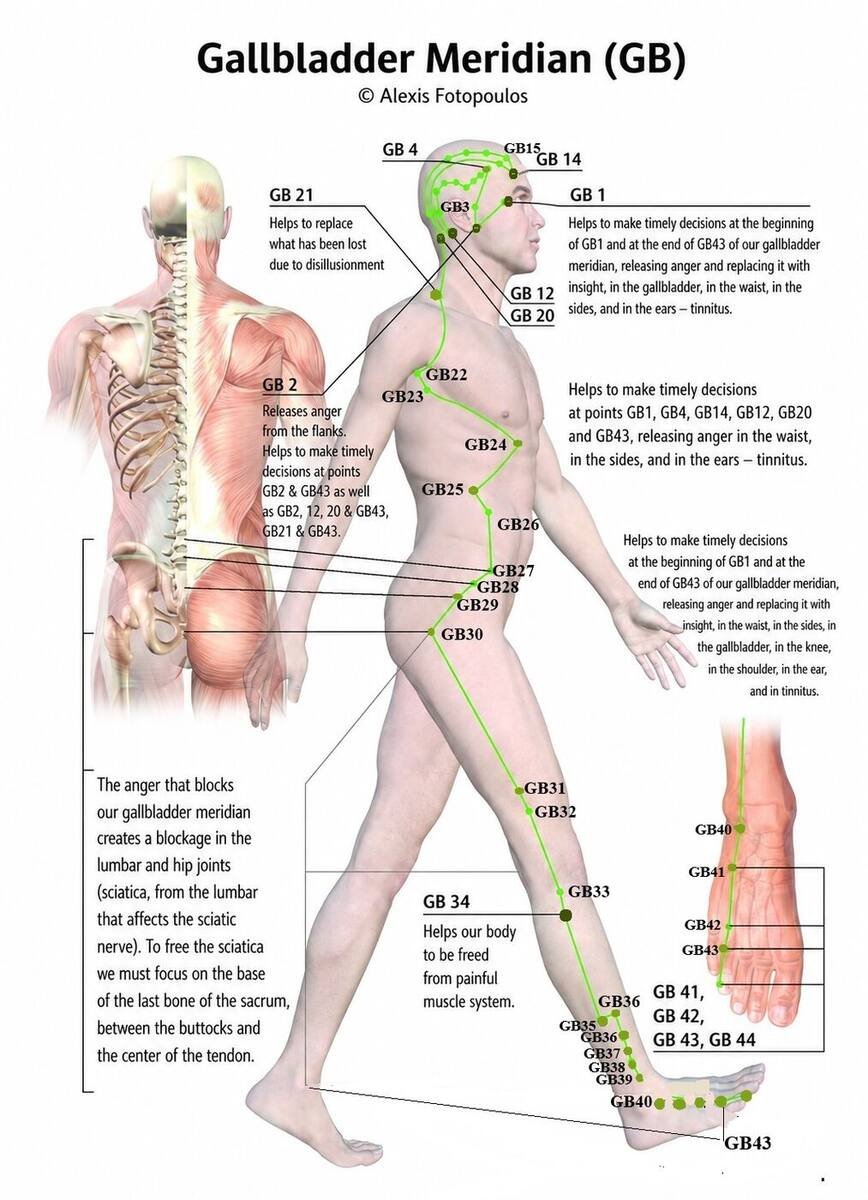
The human body is not simply a collection of separate organs. It is a living system of communication, movement, adaptation and balance.
Traditional Chinese Medicine describes one aspect of this balance through Qi and the network of meridians. In this traditional model, Qi is the vital energy that moves through pathways connecting different regions and functions of the body.
Acupressure works with specific points along these pathways using pressure from the fingers rather than needles. In my own work, I combine this traditional framework with a broader approach that looks at the person as a whole: Soul, Mind, Energy and Body.
What Is a Meridian?
A meridian is understood in Traditional Chinese Medicine as an energetic pathway. Each meridian follows a particular route and is associated, within that traditional system, with specific organs and functions.
The twelve main meridians are:
- Lung (LU)
- Large Intestine (LI)
- Stomach (ST)
- Spleen–Pancreas (SP)
- Heart (HT)
- Small Intestine (SI)
- Bladder (BL)
- Kidney (KI)
- Pericardium (PC)
- Triple Burner / San Jiao (TW/SJ)
- Gallbladder (GB)
- Liver (LV)
The important idea is not to memorize a list. It is to understand the traditional view of the body as an interconnected whole.
What Is Acupressure?
Acupressure uses many of the same traditional points known from acupuncture, but without needles. The practitioner or the individual applies controlled pressure with a thumb or fingertip to a selected point.
Pressure should be firm enough to be clearly felt, but it should not be forced or excessively painful. Depending on the purpose of the exercise, a point may be held or massaged for a short period while breathing slowly and allowing the body to relax.
In my approach, however, a single point is only part of the picture. I am interested not only in the point itself, but in the pathway to which it belongs.
From One Point to the Whole Meridian
Over more than three decades of study, observation and practical work, I developed a method based on the simultaneous activation of two or more selected points on the same meridian.
I call this method Dual-Point Meridian Activation©.
The basic principle is simple: instead of working on only one point, we activate two selected points along the same energetic pathway. In my system, acupressure, reflexology, meridian balancing and emotional work are used together as complementary tools.
Two points. One pathway. A few minutes of calm, focused activation.
I often explain the idea with the image of a river. If the flow of a river is disturbed, we do not look only at one isolated spot. We look at the course of the river as a whole. In the same way, Dual-Point Meridian Activation focuses on the relationship between points along the same pathway.
The Four Foundation Points
In A Life Full of Light, four points form a simple foundation for daily energetic practice:
- KI3 — Kidney 3
- LV3 — Liver 3
- SP6 — Spleen 6
- ST36 — Stomach 36
These four points appear in the book’s Quick Start practice and are used as a practical starting point for learning how to work with the meridian system.
They are not presented as a cure for disease. They are part of a complementary self-care approach and should be used with accurate point location and appropriate guidance.
Why Accurate Point Location Matters
Point location should never be guessed. In the book, the meridian maps use anatomical landmarks such as bones, joints and muscles to help identify each point correctly.
Before using a point, study its location carefully. Do not rely only on the point number or on an approximate region of the body. Accuracy matters, especially when points are being combined in a protocol.
Meridians and the Five Elements
Traditional Chinese Medicine also organizes the meridians through the model of the Five Elements:
- Wood — Liver and Gallbladder
- Fire — Heart, Small Intestine, Pericardium and Triple Burner
- Earth — Spleen–Pancreas and Stomach
- Metal — Lung and Large Intestine
- Water — Kidney and Bladder
Within this traditional framework, the elements are associated not only with physical functions but also with emotional patterns. This is one reason my work does not stop at pressing a point. I also look at the person’s stress, emotions, beliefs, lifestyle, sleep, movement, nutrition and spiritual life.
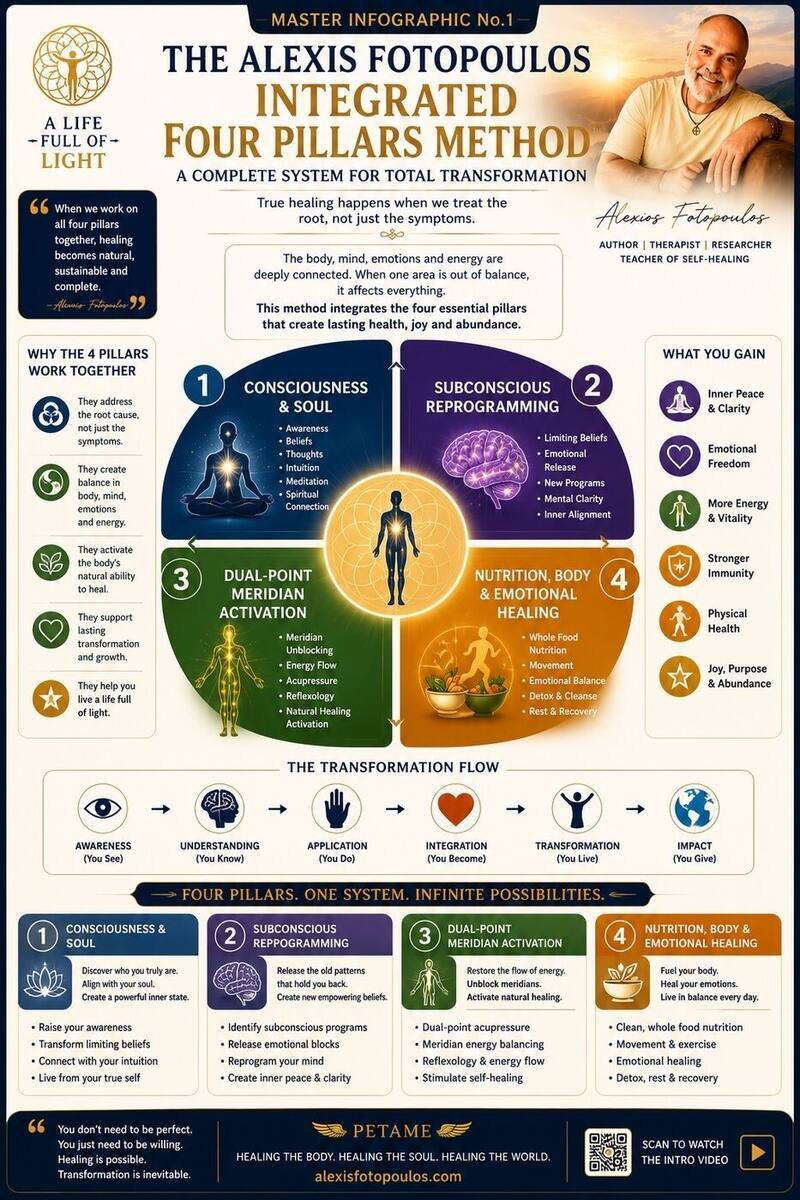
Soul, Mind, Energy and Body
The energetic dimension is only one part of the wider system presented in A Life Full of Light.
The complete approach considers four interconnected dimensions:
Soul — our spiritual life, meaning, love, gratitude, forgiveness and connection with God.
Mind — our thoughts, beliefs, memories, perceptions and subconscious patterns.
Energy — the flow of Qi through the meridians, together with acupressure, reflexology and Dual-Point Meridian Activation©.
Body — nutrition, movement, breathing, sleep, hydration and appropriate medical care.
For me, the central principle is that the human being should not be divided into disconnected parts. Lasting change is supported when we care for the whole person. You can explore this framework further on The Method and in A Life Full of Light.
A Simple Practice to Begin
If you already know the correct location of a point, begin simply:
- Sit comfortably and relax your shoulders.
- Take three slow breaths.
- Locate the point accurately using anatomical landmarks.
- Apply steady, comfortable pressure.
- Continue for a short period without forcing the body.
- Observe your breathing and how you feel.
You may finish with a few quiet moments of gratitude, prayer or simple awareness.
The purpose is not to chase an immediate result. It is to develop a calmer, more attentive relationship with your own body.
An Important Medical Note
The acupressure, reflexology, meridian practices and Dual-Point Meridian Activation© method described here are intended as complementary practices. They do not replace medical diagnosis, treatment or the advice of a qualified healthcare professional.
New, severe, persistent or unexplained symptoms should always be medically evaluated. Anyone who is pregnant or has a significant medical condition should seek appropriate professional guidance before beginning a new bodywork or acupressure practice.
Related Reading
- The Four Foundation Acupressure Points: KI3, LV3, SP6 & ST36
- Dual-Point Meridian Activation©: How the Method Works
- How to Locate Acupressure Points Accurately
- The Five Elements and Emotions in Traditional Chinese Medicine
Alexis Fotopoulos
Author · Therapist · Researcher
Soul · Mind · Energy · Body